Active Debris Removal · LEO 500–800 km

Clearing the orbits
we all depend on.

Waypoint Dynamics builds small, reusable servicers that rendezvous with derelict satellites and rocket bodies, capture them, and put them on a reentry trajectory — then recover and do it again. We are a mission services company, built by operators, for the regime where debris is no longer optional to ignore.

SCROLL · WPD-0001
LAT  52.4°N
LON  13.0°E
ALT  610 KM

Mission

A permanent infrastructure for responsible end-of-life disposal in low Earth orbit.

Waypoint Dynamics removes large, end-of-life satellites and rocket bodies from Low Earth Orbit — under contract to government and commercial clients — to preserve the long-term viability of space for all users.

We exist because orbital debris is no longer a theoretical risk. It is an accumulating liability with a legal mandate and a financial consequence for every satellite operator on Earth. We are built by operators, for operators. The discipline that made commercial aviation the safest mode of transportation in history is directly transferable to rendezvous-and-proximity operations in space — and that transfer is intentional.

35,000+ Tracked objects > 10 cm in LEO
5 yr FCC deorbit mandate — non-discretionary
$2.31B Active debris removal market · 2033
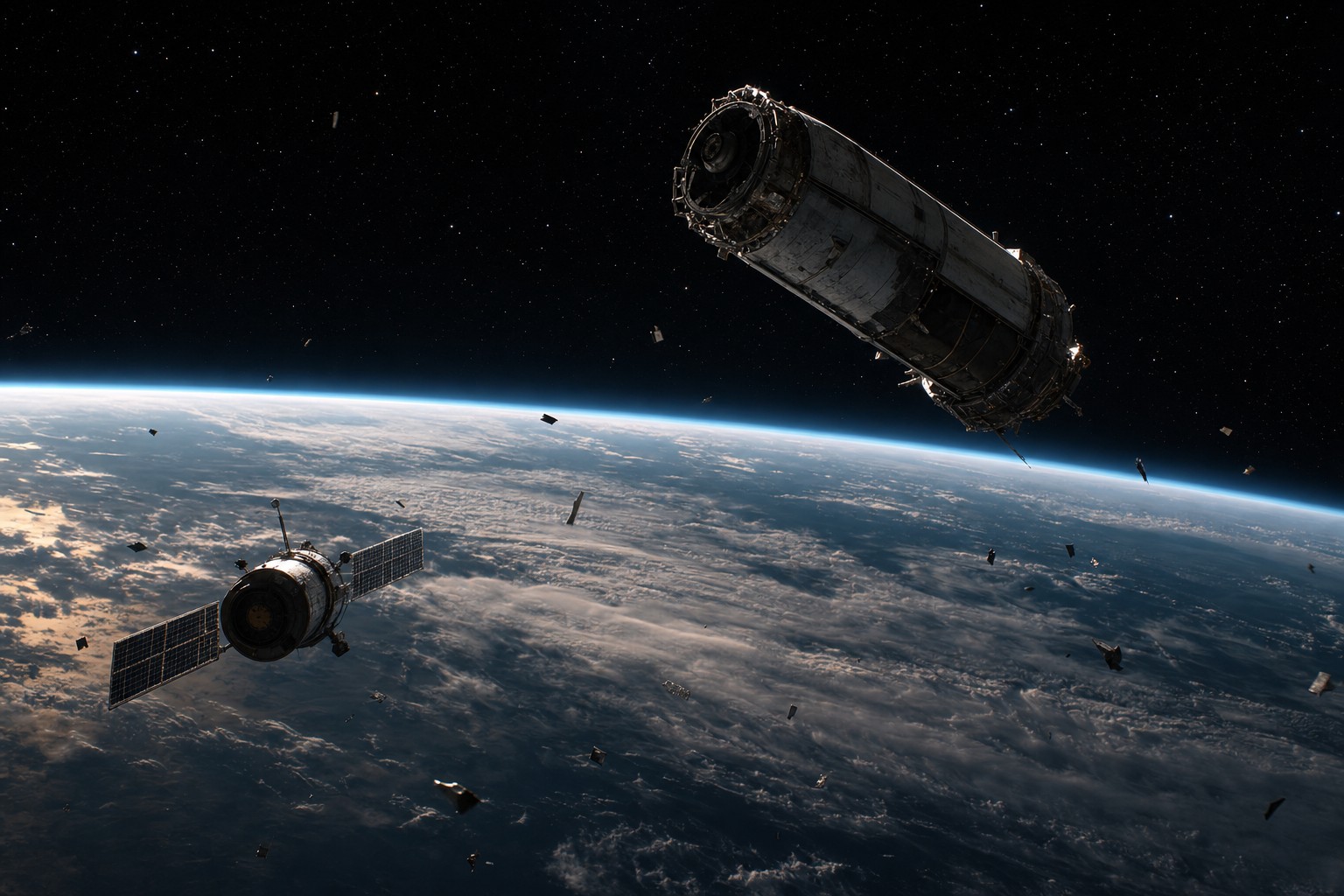
A derelict rocket upper stage and defunct satellite drifting in low Earth orbit, surrounded by fragments.

The orbital debris crisis

An accumulating liability — with a hard regulatory floor.

Each new mega-constellation adds thousands of satellites and, eventually, thousands of end-of-life disposal events. Without commercial removal infrastructure, the math does not close.

  • ~1M Untracked fragments 1–10 cm Large enough to disable an operational satellite, too small to reliably track.
  • 2024 FCC 5-Year Deorbit Rule U.S.-licensed LEO satellites must deorbit within five years of end-of-mission — replacing the prior 25-year guideline.
  • 15 km/s Closing velocities at LEO A single catastrophic collision generates a debris field capable of destroying adjacent operational satellites and triggering cascade events.

Concept Design · WPD-S/1

Sparrow.
A reusable wrangler for the 500–800 km regime.

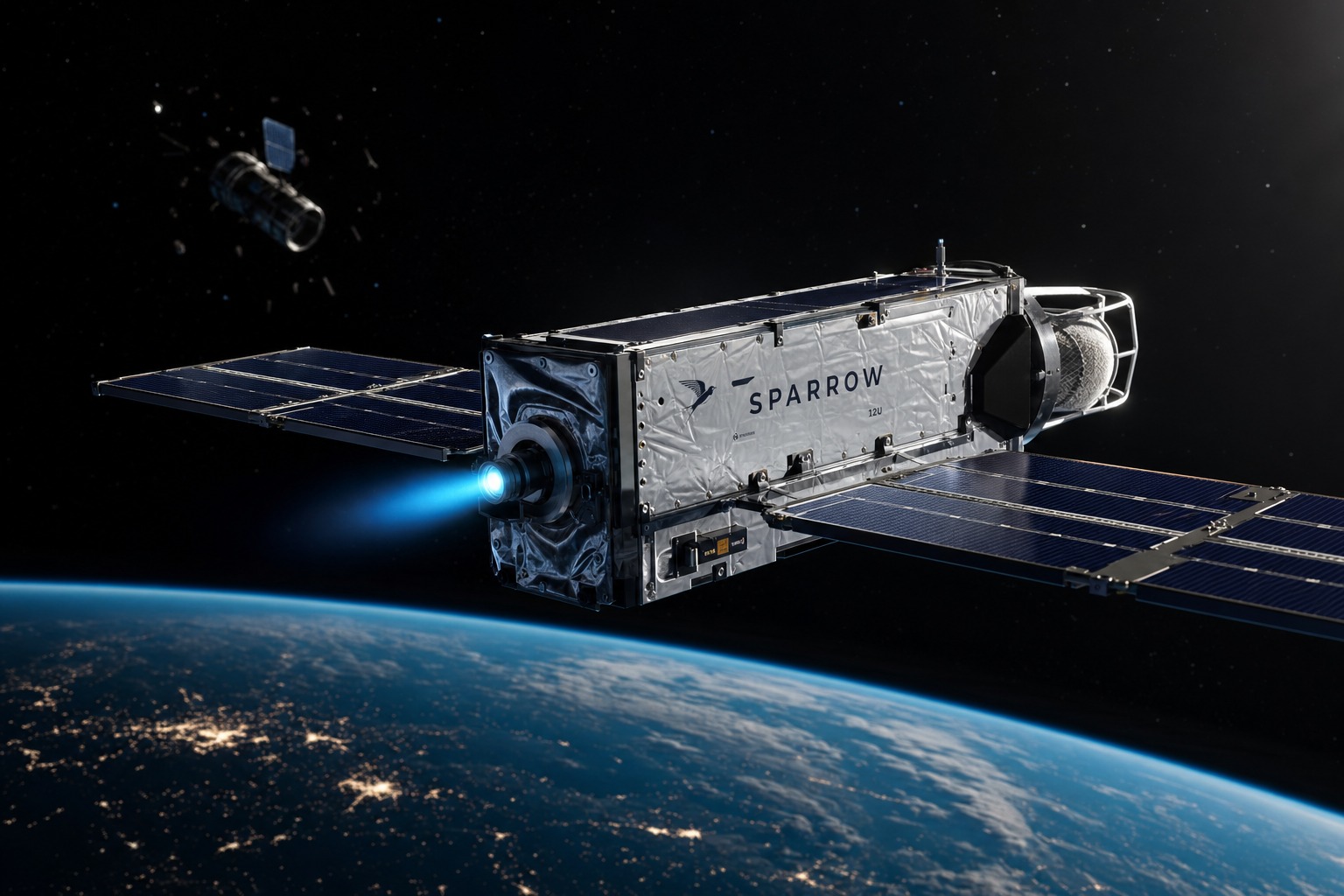
Solar-Powered Active Remediation & Re-entry Orbital Wrangler. A 12U-class servicer that rendezvous with derelict objects, captures them with a tethered net or magnetic head, imparts a retrograde delta-v with a low-thrust Hall-effect engine, and releases them onto a re-entry trajectory before recovering to a parking orbit for the next cycle. Built around three flight-demonstrated capture technologies and a flight-qualified electric propulsion stack.

A 12U-class Sparrow spacecraft on orbit, deployed solar wings, Hall-effect thruster glowing aft, with a tumbling derelict satellite in the background above Earth's curve.
SPARROW · 12U-ESPA · 32 kg WPD-S/1 — Concept
Class 12U-ESPA microsat
Wet mass ~32 kg
Power · BOL 430 W solar
Propulsion Hall · 200 W + FEEP
Target regime LEO 500–800 km
Target debris 1–50 kg per object
Specific impulse ~1,390 s
Re-use ~10 cycles / load

Configuration — capture-forward (+V), thrust-aft (−V)

FIG. 1 · WPD-S/1 · NTS
+Y +V SOLAR ARRAY · PORT ~1.5 m² TOTAL · 430 W BOL · TRIPLE-JUNCTION GaAs SPARROW 12U BUS STAR TRACKER S-BAND PATCH LiDAR · STEREO CAMERAS FEEP SECONDARY THRUSTER COLD-GAS RCS THRUST (RETROGRADE) FIRES ON SUNLIT-ARC ONLY HALL-EFFECT THRUSTER BHT-200 CLASS · 200 W · I_sp 1,390 s CAPTURE CRADLE + NET PRIMARY · TUMBLING DEBRIS MAGNETIC DOCKING HEAD SECONDARY · COOPERATIVE TGT. SOLAR ARRAY · STBD DEPLOYABLE · ROLL-OUT +V (VELOCITY VECTOR) → 12U BUS · C&DH · BATTERY · XENON / IODINE TANK · POWER ELECTRONICS

Concept of operations · single cycle

  1. Cruise & rendezvous

    Hall thruster phases altitude using Space-Track and commercial SSA catalog tracking; vision-based GNC guides approach.

  2. Proximity ops

    Closes to ~5 m with cold-gas RCS, characterizes the tumble axis, and matches rotation with FEEP-trimmed attitude control.

  3. Capture

    Tethered net for tumbling, irregular debris — primary. Magnetic head for cooperative satellites with a ferromagnetic plate — secondary.

  4. De-tumble & stack

    Tether winches in; the debris seats against the +V capture cradle and is rigidized for the deorbit burn.

  5. Retrograde burn

    Hall thruster fires retrograde over multiple sunlit arcs — a continuous spiral that walks the perigee down over days.

  6. Ejection

    Below ~150 km perigee, the cradle springs the debris free with a ~0.5 m/s tangential kick. Reentry follows within 1–3 orbits.

  7. Recovery

    Sparrow raises its own perigee back to the holding orbit and proceeds to the next target in-plane. Repeat.

Technology

Flight-heritage hardware. Aviation-grade operations.

Sparrow draws directly on three flight-demonstrated capture technologies — net, magnetic plate, drag-sail — combined with a flight-qualified Busek BHT-200 Hall thruster and an Enpulsion IFM Nano FEEP for fine proximity ops. The differentiator is not exotic hardware. It is the mission operations culture wrapped around it.

01 / GNC & RPO

Vision-based relative navigation

LiDAR point clouds, monocular and stereo vision, and onboard inference for real-time pose estimation of a tumbling, non-cooperative target. Safe-hold and abort logic built on aviation-derived crew resource management.

Heritage · RemoveDEBRIS · ADRAS-J approach
02 / Propulsion

Solar-electric, continuous, reusable

Busek BHT-200 Hall thruster: 200 W, 13 mN, Isp ~1,390 s. A 75 kg stack walks its perigee from 700 to 120 km on ~160 m/s of delta-v — about 11 days of sunlit-arc thrusting. One ~3 kg propellant load supports about ten cycles.

Heritage · Busek BHT-200 · Enpulsion IFM Nano
03 / Capture

Selectable hybrid architecture

No single capture mechanism is mandated for every target. Flight software and ground ops choose based on tumble state and geometry data gathered during approach. Net is primary; magnetic plate is secondary; drag-sail is contingency.

Heritage · RemoveDEBRIS net · Astroscale ELSA-d · NanoSail-D2
04 / Operations

Part 121 culture in a mission ops center

Written procedures for every phase. Two-operator console teams with explicit speak-up authority. A Mission Operations Director with independent scrub authority — the Part 121 dispatcher model — over the operational crew. Recurrent simulation. No improvisation during critical phases.

Heritage · 40+ years of Part 121 aviation operations
Method Use case Flight heritage Mode
Tethered net Tumbling, irregular debris; spent rocket bodies. Tolerates target tumble — a known showstopper for harpoon and robotic-arm methods on uncooperative debris. RemoveDEBRIS, 2018 Primary
Magnetic docking plate Cooperative or pre-equipped satellites carrying a ferromagnetic plate. Repeatable, reversible engagement. Astroscale ELSA-d, 2021 Secondary
Drag-augmentation sail Contingency for cases where retrograde propulsive burn fails or the target is too large to deorbit on Sparrow's own thrust budget. NanoSail-D2 · LightSail · DeorbitSail Contingency

Team

An operator-led company, deliberately so.

Engineering-led ADR companies are well-funded and technically capable. They are not the only model. Government buyers — particularly DoD — reward demonstrated operational maturity when evaluating whether a commercial provider can be trusted with proximity operations near national security assets. We were built around that reward.

CEO & Founder

Forty-eight years on the line.

Director of Flight Operations. Chief Pilot. Director of Training. A career spent inside the discipline that made commercial aviation the safest mode of transportation in human history — and a deliberate decision to import that discipline, not just its language, into the rendezvous-and-proximity-operations regime.

CTO · Open

Technical co-founder, GNC & RPO.

Senior engineer with at least one flight-heritage RPO mission. Owns technical architecture, leads the engineering team through TRL 6, principal investigator on SBIR proposals. Equity target 25–35%, four-year vest, one-year cliff. Pre-condition for full seed close.

Open roles · Year 1 hire sequence

  • CTO / Technical Co-Founder Long Beach · Boulder · Houston Founding
  • GNC Lead Engineer · Pose estimation, autonomous approach Hybrid Full-time
  • RPO Software Engineer · Flight software, simulation Hybrid Full-time
  • Systems / Mission Operations Engineer · ConOps, MOC setup On-site Full-time
  • Capture Systems Engineer · Net, magnetic head, mechanism qualification Hybrid Full-time

Contact

Get in touch.

Government program offices, commercial constellation operators, capital partners, and prospective hires — start a conversation. We respond within two business days.

Business development
Headquarters
Site selection in progress — Long Beach, CA · Boulder, CO · Houston, TX